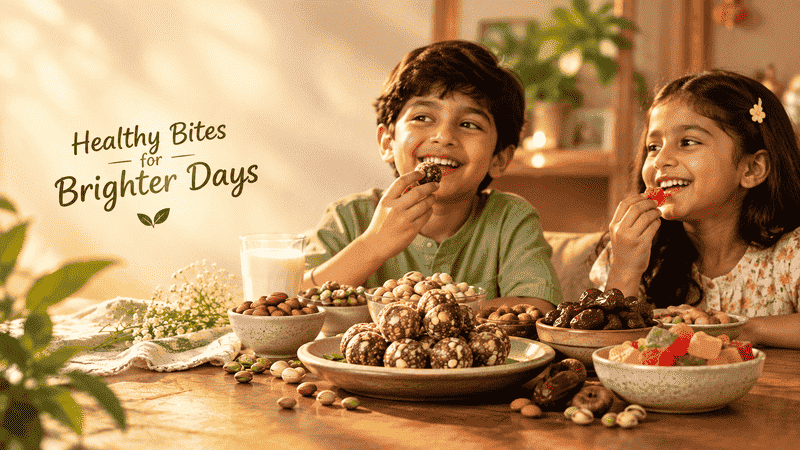
Why does one box of mithai feel like a treat, and another feel like a trap? If you've ever stood at a sweet shop counter (or just scrolled through snacks online), chances are this question has crossed your mind. On one side is the deep-fried, sugar-soaked stuff most of us grew up on. On the other, a newer crop of snacks dry fruit laddoo, fruit jelly, roasted nut mixes promising the same comfort with a little less guilt attached. The hard part is telling which of these newer options are genuinely better, and which are just old snacks wearing a "healthy" label.
This is roughly where India's packaged snack aisle stands in 2026, caught between tradition and a health-conscious rewrite. Dry fruit laddoo and fruit jelly sit right at that intersection: one leaning on the age-old reputation of nuts and dried fruit, the other reinventing a chewy, fruity treat for a generation that snacks constantly but wants to feel a bit better about it. Getting a handle on both and where they fit into the wider healthy-snacking picture makes the next trip to the sweet shop or the checkout page a lot less confusing.
What Counts as a "Healthy" Packaged Snack in India Right Now
Healthy gets stamped on a lot of Indian snack packaging, and honestly, not all of it earns the label. Right now, a more reliable definition rests on a few things: whole or minimally processed ingredients, controlled added sugar, some real nutritional value (protein, fibre, healthy fats), and honest labelling about what’s actually inside.
That last point matters more than people realise. India's snack shelves are genuinely full of ultra-processed food, and consumption of these products has climbed sharply over the past decade and a half. That growth has pushed the government to take labelling more seriously, which is part of why shoppers have started paying closer attention to ingredient lists instead of just marketing claims.
Dry fruits, nuts, and jaggery-based sweets tend to score well against this stricter definition since their ingredient lists are short and recognisable almonds, cashews, dates, a bit of ghee rather than a string of stabilisers and refined sugar. Jelly-based sweets sit in a greyer zone: some versions lean on real fruit content and natural pectin, while others are closer to flavoured sugar. The difference usually shows up the moment someone actually reads the label.
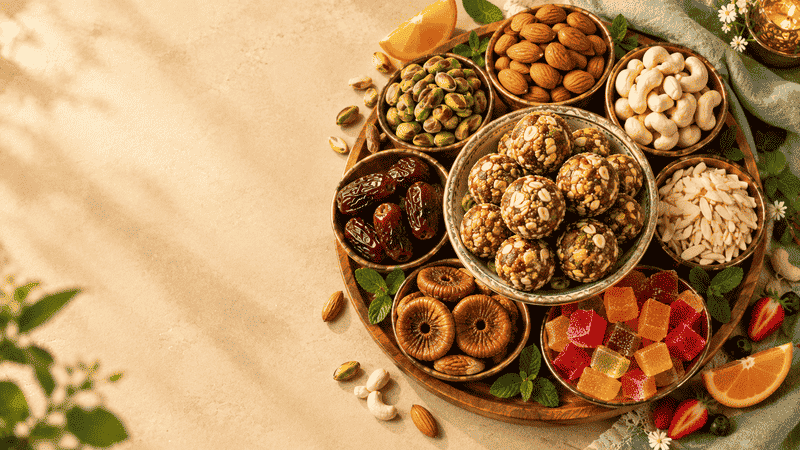
Dry Fruit Laddoo: The Traditional Sweet Getting a Health Makeover
Laddoo has been part of Indian celebration food for centuries, but the dry fruit version is having a moment of its own. Instead of being built mostly from refined flour, sugar syrup, and ghee, a good dry fruit laddoo leans on almonds, cashews, pistachios, dates, figs, and other nuts for the bulk of the recipe, often held together with just enough jaggery or ghee to keep its shape.
That shift matters nutritionally. Nuts bring monounsaturated and polyunsaturated fats that support heart health, along with fibre, vitamin E, and minerals like magnesium and potassium, according to Manipal Cigna's overview of dry fruit benefits. Dates and figs add natural sweetness along with iron and potassium, which is part of why dry fruit laddoo can feel indulgent without leaning purely on refined sugar for its flavour.
A version like the Dry Fruit Laddoo from Shree Mahalakshmi Sweets, Mysore, for instance, is built around a mix of almonds, cashews, pistachios, and other dry fruits rather than being flour-heavy roughly the template most “healthier laddoo” recipes are now following across India: fewer fillers, more actual nuts.
What's Actually Inside a Good Dry Fruit Laddoo
Not every laddoo sold as "dry fruit" earns the name. Some brands scatter a few chopped nuts over a base that’s still mostly besan, sugar, and ghee, which keeps the traditional taste but doesn’t move the needle much nutritionally. A genuinely dry-fruit-forward laddoo should list nuts and dried fruit near the top of its ingredients, not tucked at the bottom.
A few things worth checking before buying:
-
Nut-to-binder ratio: more nuts and less refined flour or sugar syrup is the goal.
-
Type of sweetener: jaggery and date paste behave differently in the body than refined sugar, releasing energy more gradually.
-
Fat source: ghee in moderate amounts is fine; hydrogenated vegetable oil is the ingredient to watch for.
-
Portion size: laddoos are calorie-dense by nature, so a smaller, nut-rich one beats a large one padded with filler.
The ICMR-NIN 2024 Dietary Guidelines for Indians recommend nuts and oilseeds as a daily part of a balanced plate generally a small handful, around 30 grams which works out to a couple of dry fruit laddoos on an occasional basis rather than a daily habit, depending on their size and sugar content.

Fruit Jelly: The Fun Snack That's More Than Just Sugar
Fruit jelly occupies a different lane entirely. It's chewy, colourful, and has always read a little more like a children's treat than a health food, though the category has been evolving. Traditional Indian fruit jellies, like the ones made by petha specialists in Agra, are built around fruit pulp or fruit-based petha (ash gourd) set into a soft, jelly-like texture with sugar syrup, rather than starting from artificial gelatin and flavouring alone.
The Fruit Jelly from Pracheen Petha, Agra is a good example of this style a soft, chewy sweet with mixed fruit flavours, positioned as much for everyday snacking and gifting as for festive occasions. Because it leans on real fruit character rather than pure sugar syrup, it tends to sit closer to the “treat, not junk” end of the spectrum than a mass-market gummy candy would.
That said, fruit jelly is still a sugar-forward sweet, and it doesn't carry the same protein or healthy-fat profile that nuts do. The honest way to think about it: fruit jelly is a lighter, more fruit-driven alternative to heavier syrup-soaked mithai, not a health food in its own right. It earns its place in a snack rotation as the “something sweet and fun” option rather than the nutritional anchor.
Dry Fruit Laddoo vs Fruit Jelly: Which One Fits Your Day
These two snacks aren't really competing for the same moment, which is part of why they work well together in a snack line-up.
Dry fruit laddoo tends to suit mornings, pre-workout energy needs, or a mid-afternoon slump, since the fat and fibre from nuts slow digestion and provide steadier energy. It's also more filling per bite, so a smaller portion tends to satisfy.
Fruit jelly fits better as an after-meal sweet bite, a kids’ lunch box addition, or a festive-season nibble alongside other mithai. It’s lighter, quicker to eat, and doesn’t carry the same "basically a meal replacement" density that a nut-heavy laddoo does.
Neither one needs to win. A household that keeps a small box of dry fruit laddoo for energy and a box of fruit jelly for treat moments is covering two very different snacking needs, without leaning on fried namkeen or heavily processed candy.

How FSSAI’s New Labelling Push Is Changing What "Healthy" Means
Snack labelling in India is in the middle of a genuine overhaul, and it's worth knowing about since it will likely change how “healthy” gets communicated on packaging over the next couple of years.
Following pressure from the Supreme Court, the Food Safety and Standards Authority of India has proposed mandatory front-of-pack warning labels for foods that are High in Fat, Sugar, and/or Salt a red hexagonal symbol reading "High Sugar," "High Salt," or "High Fat," based on thresholds drawn from the ICMR-NIN 2024 Dietary Guidelines. Interestingly, the current proposal exempts single-ingredient products and foods naturally rich in sugar or fat, including jaggery and honey, which is relevant for anyone comparing a jaggery-sweetened dry fruit laddoo against a candy built on refined sugar.
This regulatory push has been years in the making, and public health experts have flagged gaps in how the warning thresholds are set. But the direction is clear: packaged snacks in India are heading toward more transparent, harder-to-ignore labelling. For dry fruit laddoo and fruit jelly buyers, that's good news it will make it easier to tell a genuinely nut-forward laddoo apart from a sugar-heavy one just by glancing at the front of the pack, rather than hunting through fine print.
Smart Ways to Add Dry Fruit Laddoo and Fruit Jelly to Your Week
Neither of these snacks needs an elaborate meal plan built around it; they work best as small, intentional additions.
A single dry fruit laddoo works well as a mid-morning or pre-workout bite, especially for anyone who skips breakfast or needs sustained energy before a gym session. Because it's calorie-dense, one piece is usually enough; pairing it with a glass of water or milk helps balance out the richness.
Fruit jelly fits naturally after a meal, as a lighter dessert alternative to something fried or cream-heavy. It's also a reasonable lunch box addition for kids since its chewy texture and bright flavour tend to appeal to children more than plain dried fruit, while still avoiding some of the artificial colouring found in cheaper gummy candies.
During festive weeks, when snacking naturally increases, rotating between a few dry fruit laddoos, a couple of pieces of fruit jelly, and some plain roasted nuts tends to keep both variety and portion control in check, rather than defaulting to whatever fried snack happens to be closest at hand.
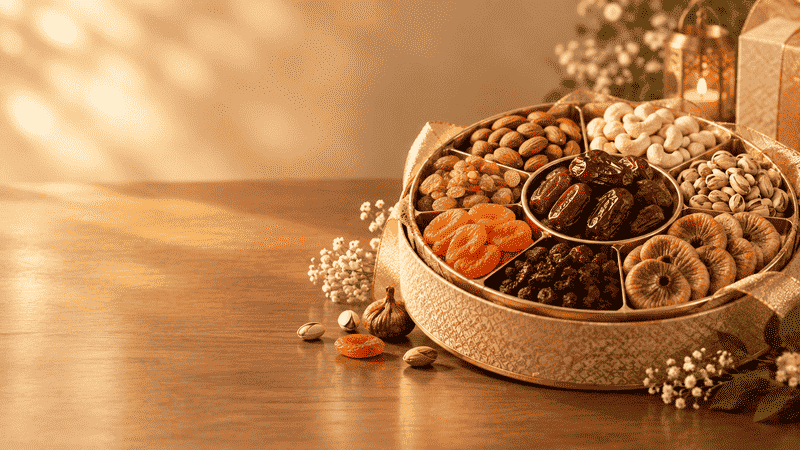
Gifting Season: Why Dry Fruit Sweets Are Winning Over Classic Mithai
Diwali, Akshaya Tritiya, Rakhi, and wedding season have traditionally meant boxes of syrup-soaked classics like gulab jamun, motichoor laddu, and kaju katli. That's still true, but dry fruit-based sweets have been steadily gaining ground as the gifting choice for health-conscious buyers.
Part of the appeal is practical: dry fruits and dry-fruit-based sweets typically have a longer shelf life than syrup-based mithai, which takes the stress out of spoilage during the shipping and storage that festival gifting involves, as noted in a 2026 guide to Diwali dry fruit gifting. Part of it is perception, too a gift box of dry fruit laddoo or a mixed nut hamper reads as more premium and more thoughtful than a standard sweet box, without necessarily costing more.
Sweet shops have caught on to this shift as well. Several festive collections built specifically around dry-fruit sweets positioned as offering "eternal" prosperity without the heaviness of a fully sugar-based spread have appeared for occasions like Akshaya Tritiya, reflecting a broader move toward festive food that doesn’t force a choice between tradition and wellness. Fruit jelly fits into this gifting rotation too, usually as a lighter, colourful addition alongside heavier dry fruit sweets in a mixed hamper.
Picking Snacks You Can Actually Trust (Quality Checklist)
With so many brands now using "healthy," "premium," and "natural" as marketing words rather than accurate descriptions, a short mental checklist helps cut through the noise before buying dry fruit laddoo, fruit jelly, or any other packaged snack:
-
Check the ingredient order: nuts and fruit should appear early in the list, not buried after sugar and oil.
-
Look for the FSSAI license number: a legitimate manufacturer will always display this on the package.
-
Scan for hidden fats: palm oil or hydrogenated fat listed high up is a signal to look elsewhere.
-
Note the sweetener type: jaggery, dates, and honey behave differently in the body than refined sugar, even if the label doesn't shout about it.
-
Watch portion sizes on the pack: a "serving" on Indian snack packaging is sometimes smaller than what people actually eat in one sitting, which can understate sugar and calorie counts.
-
Buy from sellers who specify sourcing: brands that name the region or supplier, the way Mysore-based or Agra-based sweet makers often do, tend to be more transparent overall than anonymous private-label packs.
None of this requires becoming a full-time label detective. It just means giving the back of the pack fifteen seconds of attention before it goes into the cart, a habit that gets easier once FSSAI's new front-of-pack warning system rolls out more widely.
Key Takeaways
-
Dry fruit laddoo built mainly from nuts and dates offers genuine nutritional value: healthy fats, fibre, iron, and steady energy as long as nuts appear early in the ingredient list.
-
Fruit jelly, especially traditional fruit-based versions, is a lighter treat option than syrup-heavy mithai, though it still leans on sugar and shouldn't be mistaken for a health food.
-
India's healthy and on-the-go snacking market is growing fast, from roughly USD 3.13 billion to a projected USD 4.77 billion by 2034 for healthy snacks overall, and even faster for on-the-go formats.
-
FSSAI's proposed front-of-pack warning labels will likely make it much easier to spot genuinely better snacks at a glance in the next few years.
-
Dry fruit sweets are increasingly replacing or supplementing classic syrup-based mithai in festive gifting, thanks to longer shelf life and a more premium, wellness-forward image.
-
A short ingredient and labelling checklist nut position, sweetener type, fat source, FSSAI license goes a long way toward separating genuinely better snacks from relabelled junk food.
FAQ
Q: Is dry fruit laddoo actually healthier than a regular laddoo?
A: Generally, yes, when nuts and dried fruit make up most of the recipe rather than refined flour and sugar syrup. It offers more fibre, healthy fats, and micronutrients, though it's still calorie-dense and best eaten in moderate portions.
Q: How many dry fruit laddoos is it okay to eat in a day?
A: One to two pieces on an occasional basis is a reasonable guideline, roughly in line with the daily handful of nuts recommended in India's dietary guidelines, though this depends on the laddoo's size and added sugar content.
Q: Does fruit jelly contain real fruit?
A: It depends on the brand. Traditional Indian fruit jellies, especially those made by established petha and mithai makers, are typically built around fruit pulp or fruit-based bases, while mass-market gummy candies often rely mainly on flavouring and colour rather than actual fruit content.
Q: Are dry fruit laddoo and fruit jelly good options for kids?
A: Both can work in moderation. Dry fruit laddoo offers more nutritional value but should be given in small portions due to its calorie density and, for very young children, potential choking risk from whole nut pieces. Fruit jelly is generally easier for kids to eat and enjoy, though it's best treated as an occasional sweet rather than a daily snack.
Q: Why is dry fruit gifting becoming more popular than traditional mithai during festivals?
A: Longer shelf life, a more premium perception, and a genuine wellness angle are the main drivers. Dry fruit sweets travel and store better than syrup-based mithai, which matters a lot for festival shipping and gifting.
Q: How can shoppers tell if a packaged snack is genuinely healthy or just marketed that way?
A: Check the ingredient list order, look for the FSSAI license number, note the type of sweetener used, and watch for hidden fats like palm oil. Once FSSAI's proposed front-of-pack warning labels roll out more widely, this kind of check should get considerably faster.
Explore DeliciousKart for dry fruit laddoo, fruit jelly, sweets, and thoughtfully selected snacks for everyday treats and festive gifting.