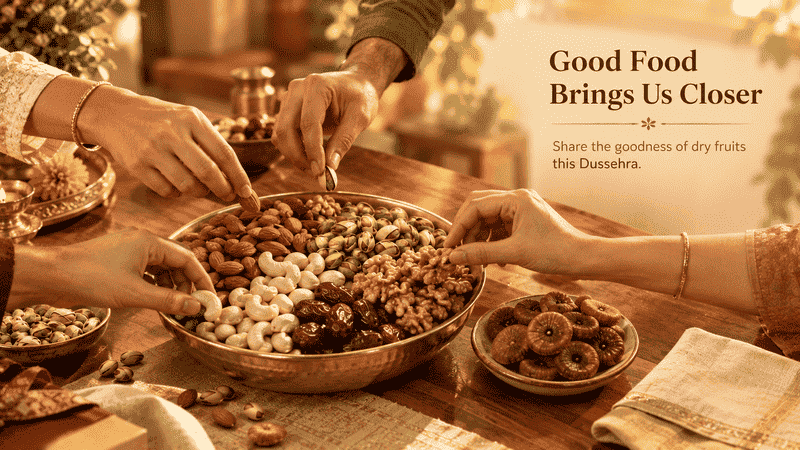
Quick question. When was the last time you got a Dussehra gift you still remembered a week later? Not the sweets box. Those vanish by dinner. I mean something that sat in your kitchen and slowly became part of your routine.
For me it’s always been dry fruits. We had this steel dabba at home that my mom guarded like it held state secrets. It only opened when guests came or when somebody had a rough exam day. Almonds, cashews, a few raisins that had clearly given up on life. I didn’t think much of it back then. Now I think it was the smartest gifting system ever invented.
This year Dussehra falls on Tuesday, 20 October, so it’s barely a week away. If you’re still staring at a blank who-gets-what list, same. This is the guide I wish I’d had. It covers how we think about a Dussehra special hamper, why family packs deserve more love, and what’s going on with prices. Spoiler: it’s not pretty.
Why Dussehra gifting is quietly becoming a thing
Diwali gets the glitter. Dussehra gets the Ramlila, the giant Ravana effigies and jalebi at the mela. Gifting has always been there too, but sort of in the background. A box of mithai, maybe an envelope for the house help. I think that’s changing, and not only because brands love a fresh occasion to sell things.
Part of it is timing. Dussehra comes at the end of Sharad Navratri, which runs from 11 to 20 October this year. A lot of families are fasting or eating lighter through those nine days, and honestly, after that much sabudana and fruit, a heavy ghee-laden sweet feels like too much. Dry fruits fit. Makhana, dates and almonds are things many people already eat on vrat days. (Rules differ so much between families that I’d check what your recipient follows before you buy anything fancy.)
There’s also the Diwali factor. Dussehra is basically the warm-up round. Offices, vendors, neighbours, everybody’s about to be buried in gifting, so plenty of people send theirs early to stay ahead of the chaos. And the pressure is lower. Nobody expects a gold coin at Dussehra. A thoughtful box with a handwritten note does the job just fine.
I like shopping now for a boring reason too. Stores aren’t completely insane yet, and you can still pick things up and look at them.
What actually goes into a good dry fruit hamper
Let’s start with what a hamper is, because the word covers a huge range. At one end there’s a plastic tray with seven compartments, each holding about a spoonful of something. At the other end there’s a proper wooden box, a few hundred grams of really good nuts, maybe a brass diya tucked in the corner.
The core is usually almonds, cashews, pistachios and walnuts. Then come the sweeter things: raisins, dates, dried figs (anjeer), apricots. Better Dussehra special dry fruit hampers add a couple of surprises, like roasted makhana or dried cranberries, sometimes a few cubes of jaggery. Some brands toss in a chocolate or a diya, which is cute, but I’d never pay extra for it.
Here’s my slightly opinionated take. A dry fruit gift box with twelve tiny compartments looks gorgeous and feels a bit sad when you open it. I’d rather get four or five things in a decent quantity. Nobody’s ever finished a 15-gram sachet of pistachios and thought, wow, generous.
Packaging matters, but not for the reasons ads suggest. Sealed trays or vacuum pouches mean the stuff stays fresh longer. Shiny boxes just mean the box is shiny. If you’re buying premium dry fruits, flip the box over and look at what’s actually written on it: weight per item, packing date, FSSAI licence number. That tells you much more than the ribbon does.
Also, the weight on the front isn’t always the weight of nuts. Sometimes it’s the weight of nuts plus the tray plus the tiny decorative thing. Read the net weight.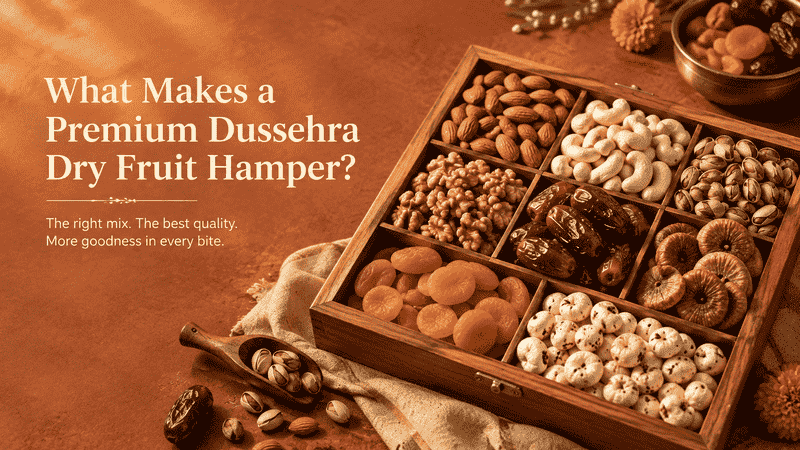
The price situation (and why your hamper might cost more this year)
Okay, brace yourself a little. Dry fruit prices in India have been rough this festive season, and it’s not just you imagining things at the shop counter.
Trade reports say in-shell pistachios are running 60 to 70 percent higher than last Diwali, almonds are up 20 to 40 percent depending on the variety, and cashews have risen only 5 to 8 percent. Raisins, dates and figs have all crept up too, though far more gently, in the low single digits to maybe 15 percent for figs. The blame mostly lands on supply trouble from Iran and Afghanistan, plus pricier freight from the Middle East and shipping delays on Californian almonds. If you want the full picture, FreshPlaza’s report lays it out.
The one calm corner is cashews. Cashew prices have stayed steady heading into the festive window, and whole cashews are selling at roughly ₹900 to ₹1,000 per kg, according to this trade piece. The same report says traders expect festive dry fruit sales to dip by around 10 to 15 percent as people switch to cheaper options like makhana and pumpkin or sunflower seeds.
So what do we do with that? A few things.
First, don’t assume the priciest hamper is the best one. A pistachio-heavy box is going to carry a steep premium right now, and a cashew-and-raisin-forward box can be just as lovely. Second, compare by price per 100 grams, not by sticker. Third, these are national trade figures. Your local mandi or your favourite online store might move differently, so treat all of this as a rough guide and not gospel.
Family packs: the underrated hero of the festival
Nobody writes poems about the family pack. It’s a bag. Usually a resealable pouch with 500 grams or a kilo of mixed stuff in it. Not glamorous.
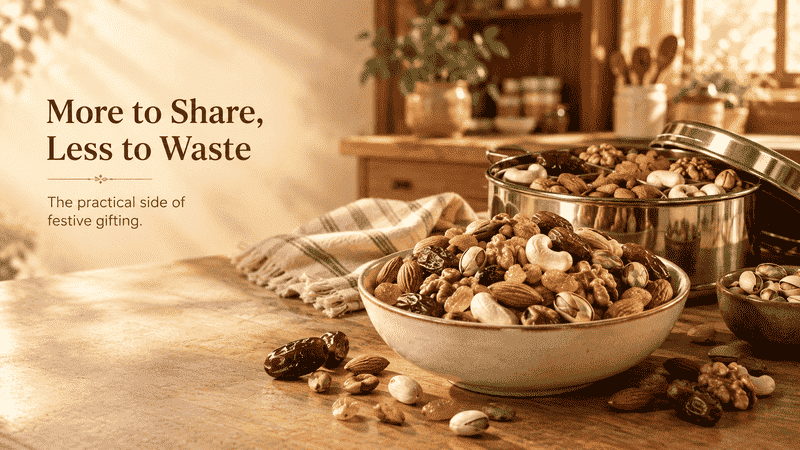
But I’ll tell you what happens in real life. The fancy hamper that arrives at home sits on a shelf as decoration for three weeks because nobody wants to break the arrangement. The family pack of mixed dry fruits gets opened on day two, and by day ten there’s a mild argument about who finished the cashews. One of those things is actually serving its purpose.
Family packs also win on cost. You’re not paying for the box, the ribbon or the tiny wooden spoon, so more of your money goes toward actual food. That matters a lot this year, with almond and pistachio prices what they are.
As gifts, they’re perfect for particular people: a big joint family, the relatives hosting everyone for Dussehra lunch, or the aunt who feeds the entire street. I’d say gift a family pack dry fruits option to anybody who has a lot of mouths at home, and a smaller hamper to people who live alone or want something pretty.
One caution. Check the mix ratio. Some budget packs are mostly raisins with a handful of almonds as a garnish. The label usually lists the share by weight, and if it doesn’t, that tells you something too. A decent festive pack should have a meaningful amount of almonds and cashews, not just a few lonely ones hiding at the top.
How to pick without getting fleeced
I’m not a food technologist, so none of this is lab-level. It’s just what I’ve learned from buying a lot of dry fruits and being disappointed a lot.
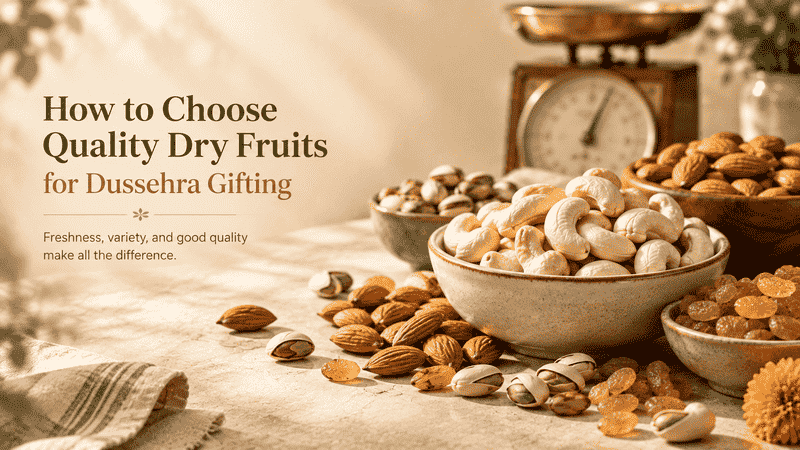
Smell first. Good nuts smell mildly sweet or like nothing much. If you get a sharp, paint-like or stale-oil smell, the fats have gone rancid and it’s not worth gifting. Almonds should snap crisply. If they bend or feel chewy, they’ve been sitting around or absorbed moisture. Cashews should be pale ivory and mostly whole, not yellow or spotted. Raisins ought to be plump, not sticky and sugar-crusted, and dates should be soft but not mushy.
Then the label. Look for a packing date, a best-before date with plenty of runway, and a licence number from FSSAI. If you can’t find any of those, put the box down. Colours that look too bright to be real usually deserve a second look as well, especially on apricots and dried fruit.
On buying versus building, I go back and forth. Building your own is cheaper and honestly kind of fun. You buy loose from a shop you trust, pack it in a nice box or a steel container, and it looks personal. Readymade hampers save time and look finished. If you want something in between, buy dry fruits online from a seller with a clear return policy, then repackage them yourself. Shipping delays do creep up closer to Diwali, so order sooner than you think you need to.
Who gets what
Gifting always feels easier once you stop thinking “dry fruit hamper” and start thinking about the actual person.
For parents and older relatives, go simple and soft. Dates, figs, almonds that are easy to chew, maybe walnuts. A smaller, high-quality box beats a giant fancy one. If anyone has diabetes, look for unsweetened items and skip the candied stuff, and when in doubt, ask a family member quietly.
For colleagues and your boss, that’s where the corporate dry fruit gift boxes come in, and I’d keep it classy and boring. Clean packaging, nothing too heavy, no strong flavors. A plain box with almonds and cashews says “I thought of you” without any awkwardness. For a whole team, one decent family pack in the pantry might actually do more than ten individual boxes.
Neighbours, I’d say, get the mid-range hamper with a handwritten note. The note matters more than you’d expect.
Kids like the fun stuff: flavoured makhana, chocolate-dipped almonds, those little mixed trail snacks. Fine, it’s not the healthiest, but it’s Dussehra. Nobody ever remembered a festival for how restrained they were.
And for the house help, drivers and the guy at the building gate, a family pack is quietly one of the nicest things you can do. It feeds a household. That’s the whole point, really.

A quick word on health, because someone has to say it
Dry fruits are good for you. They’re also dense with calories. Both things are true, and I wish more gift boxes said so.
India’s national nutrition guidelines are pretty clear that nuts and oilseeds are valuable, but in modest amounts. One summary of the ICMR-NIN guidelines says nuts, oilseeds, fatty fish and cooking oils together should be limited to about 25 to 30 grams a day. That’s roughly a small handful, not the entire box in one sitting during a Ramlila.
A few practical notes. Salted or masala-roasted nuts add sodium fast, and the guidelines also lean toward restricting salt and sugar and reading food labels. Candied fruit and sweetened cranberries are basically sweets in disguise. Anyone with a nut allergy should be kept far away from mixed boxes, since cross-contamination in packing facilities is real, and the allergen note on the label deserves your full attention.
Storage matters too. Keep everything in airtight containers, away from sun and damp. If you’ve bought in bulk, the fridge helps nuts last longer, especially in humid weather.
None of this is medical advice. If you or the person you’re gifting has diabetes, a heart condition or a restricted diet, a quick chat with their doctor is better than anything I can say.
Key takeaways
-
Dussehra falls on 20 October this year, so ordering this week is smart. Check your local panchang for exact timings.
-
Pistachio and almond prices are way up while cashews are comparatively steady, so a cashew-forward hamper is the budget-friendly play.
-
Family packs often give you more actual food per rupee, and they get eaten instead of displayed.
-
Read the label: net weight, packing date, FSSAI licence and the mix ratio.
-
Match the gift to the person. A diabetic parent, a busy boss and a hungry joint family all need different boxes.
-
Keep portions sensible, since national guidelines suggest a modest daily amount, not a feast.
FAQ
Q: When is Dussehra in 2026?
A: Most calendars list it as Tuesday, 20 October 2026, and the auspicious Vijay Muhurat is listed as 2:00 PM to 2:46 PM. A few sites show different dates, so check a local panchang for your city before planning anything time-sensitive.
Q: How much should I spend on a dry fruit hamper?
A: There’s no magic number. I’d decide a budget first, then compare per 100 grams instead of looking at box size. Cashew-led and mixed options usually cost less right now than pistachio-heavy ones.
Q: Is a family pack a good gift or does it look cheap?
A: Depends who it’s for. For a big household, a good family pack is more useful than a pretty tray. Add a handwritten note or tie it with a ribbon and it looks thoughtful, not stingy.
Q: Are dry fruit hampers okay for people with diabetes?
A: Plain, unsweetened nuts in small portions are generally fine for many people, but dates, figs and candied fruit are high in sugar. Ask their doctor or a family member, and look for sugar-free hampers.
Q: How long do dry fruits stay fresh?
A: In an airtight container, in a cool dry spot, usually a few months. Nuts can go rancid faster in heat and humidity, so refrigerate them if you’re keeping them longer. Always check the best-before date on the pack.
Q: When should I order a hamper?
A: As early as you can. Demand picks up fast heading into Diwali, and delivery slows with it. If it needs to reach another city, I’d order this week.
So, what are we actually buying?
Here’s where I’ve landed. I’m getting one nice hamper for my parents, a cashew-heavy one, because the prices are kinder and honestly that’s what my dad snacks on anyway. Then one big family pack for home, and a couple more to hand out to the people who help us out all year and rarely get thanked.
That’s it. No grand plan. A box, a bag and a couple of notes.
I keep thinking about my mom’s steel dabba. Nobody ever remembered what was inside it by brand or price. What stayed was that it was there when people came over, and that somebody had thought to keep it full. That’s the whole idea of a Dussehra special gift, I think. It doesn’t need to be fancy. It needs to get opened.
Celebrate Dussehra with the goodness of dry fruits. Explore DeliciousKart today and make every festive gift count!