

There are few sweets in the world that carry as much cultural weight as the rasgulla. Soft, white, spongy, and soaked in a delicate sugar syrup, this iconic Bengali dessert has been bringing joy to millions of households for generations. Yet, despite its simple appearance, making an authentic rasgulla the traditional way is a craft that takes patience, intuition, and a deep respect for the process. It is not just about following a recipe, it is about understanding the chemistry of milk, the rhythm of kneading, and the art of knowing exactly when your chenna is ready.
In an era of instant desserts and store-bought shortcuts, the traditional method of making rasgulla stands apart as something truly special. If you have ever bitten into one of those perfectly round, feather-light balls and wondered how it came to be, this article is for you. We are going to walk through every stage of the traditional process, from splitting the milk to simmering the finished balls in syrup, so you can appreciate, and perhaps recreate, this timeless sweet.
The Soul of Rasgulla: Fresh Chenna
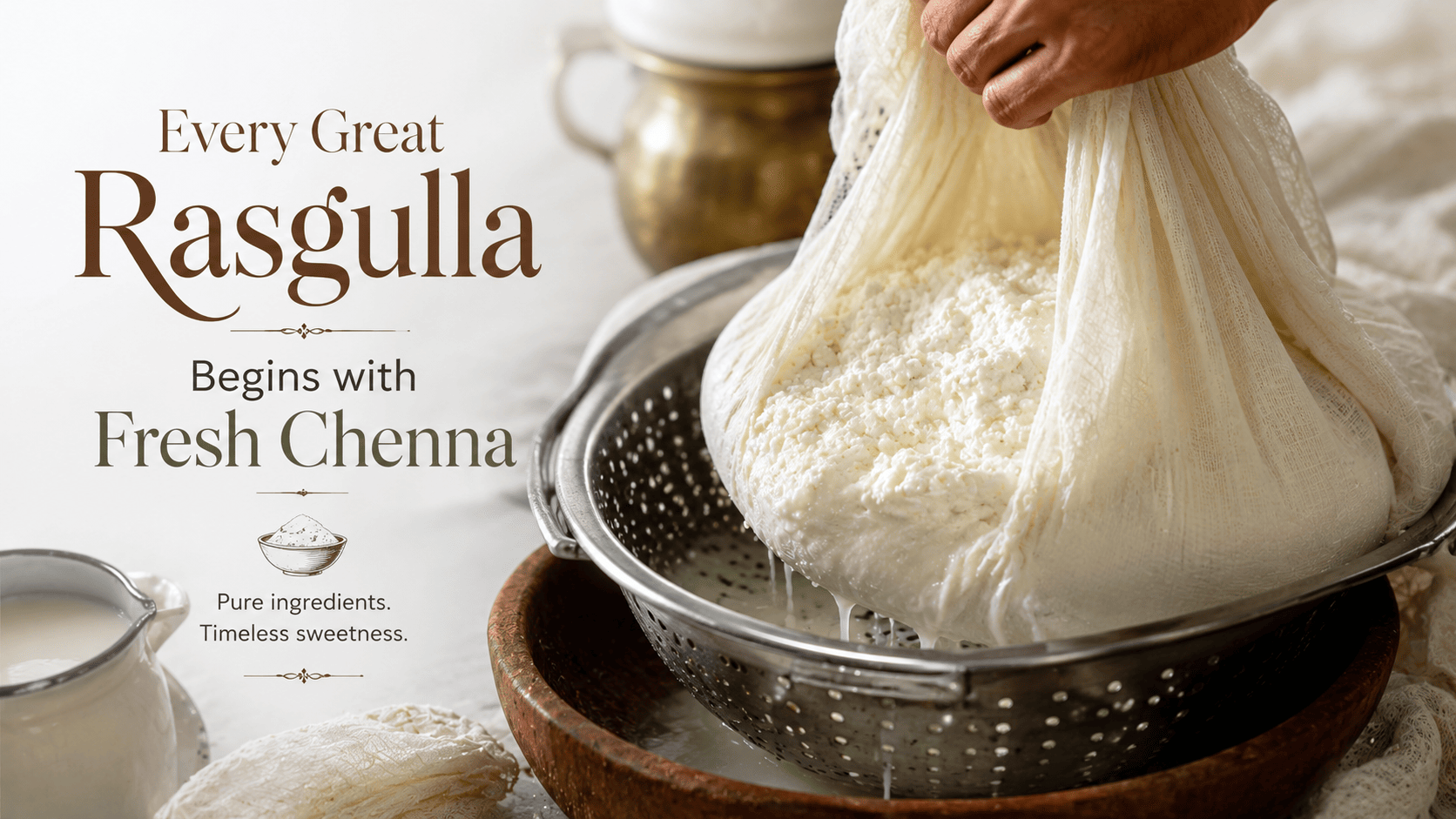
Everything begins with chenna. Chenna is essentially fresh, unsalted cottage cheese made by curdling full-fat milk and draining the whey. It is the heart of the rasgulla, and the quality of your chenna determines almost everything about the final product.
Traditional makers swear by full-fat cow's milk, though buffalo milk is also used in some regions. The milk is brought to a rolling boil in a heavy-bottomed vessel, traditionally a kadhai, while being stirred continuously to prevent a skin from forming. Once it reaches a full boil, the heat is lowered and an acidic agent is added to curdle the milk.
The choice of curdling agent is where traditional recipes diverge. Some families use lemon juice, others prefer vinegar, and certain old-school halwais (sweet makers) insist on using the whey from a previous batch, a practice that creates a gentler curdling and a softer chenna with a slightly tangy, complex flavour. The acidic agent is added slowly, a little at a time, with the milk being stirred gently. You stop adding the moment the milk solids separate cleanly from the greenish whey. Over-acidifying the milk produces a grainy, hard chenna that will never yield a soft rasgulla.
Once curdled, the chenna is poured into a muslin cloth and rinsed thoroughly under cold running water. This step is essential, it washes out the acidity and cools the chenna down, stopping the cooking process. The cloth is then tied and hung to drain for approximately 30 minutes. You want the chenna to be moist but not wet, with no free water dripping from it. Press the bundle between your palms, and if it holds its shape without releasing water, it is ready.
The Kneading: Where Patience Becomes Texture
If splitting the milk is science, kneading the chenna is art. This step is what separates an ordinary rasgulla from an extraordinary one, and it is the part of the process that traditional makers will tell you cannot be rushed.
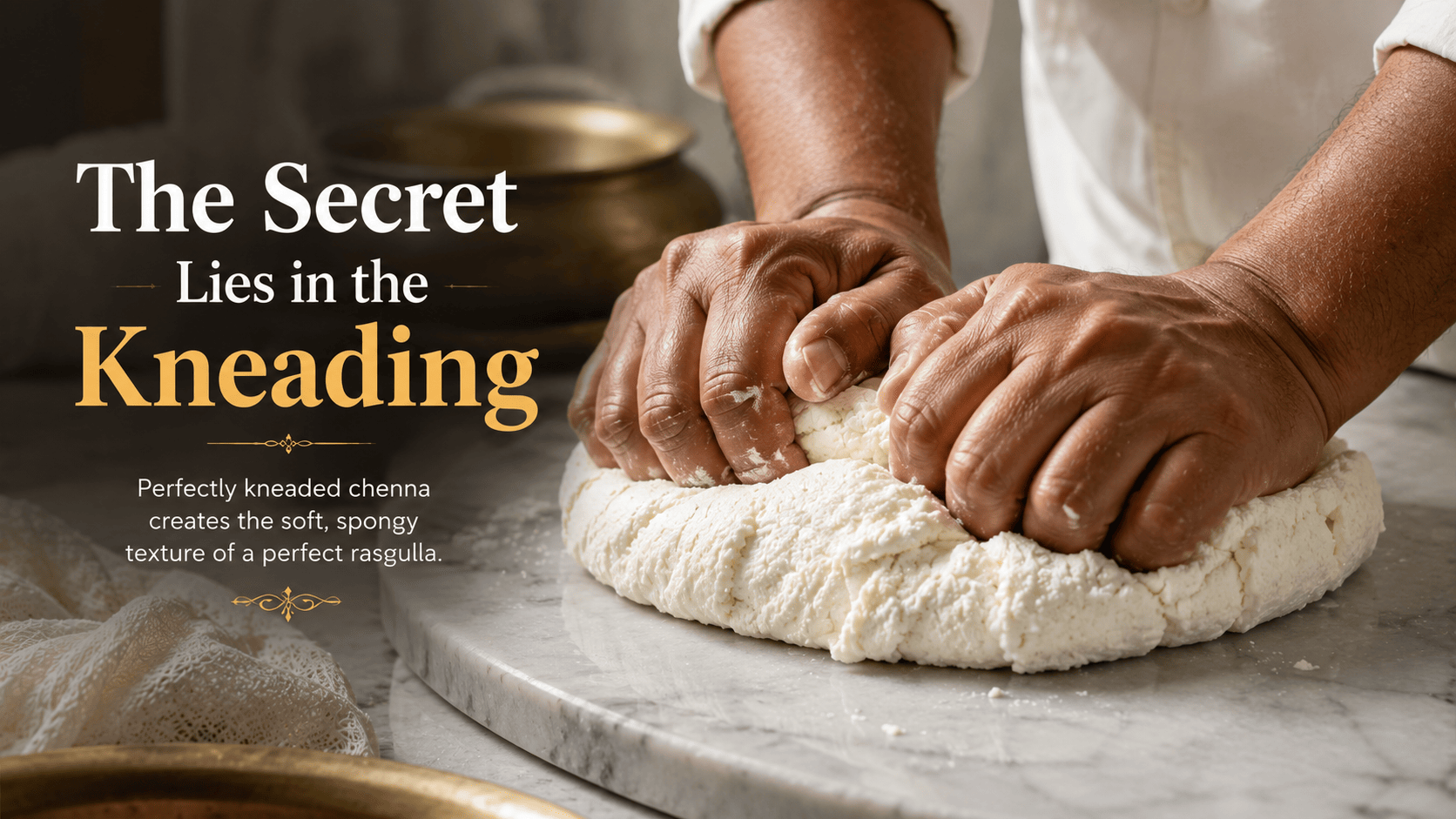
The drained chenna is turned out onto a clean flat surface, traditionally a marble slab or a large wooden board, and kneaded by hand. The motion is deliberate and rhythmic, using the heel of your palm, you press, fold, and stretch the chenna repeatedly. The goal is to break down any residual graininess, develop a smooth, almost paste-like consistency, and slightly warm the mixture through body heat and friction.
How long does this take? Traditional recipes say you should knead for a minimum of 10 to 15 minutes, and experienced halwais can go up to 20 minutes for a particularly large batch. You know the chenna is ready when it stops sticking to your palms, comes together as a single cohesive mass, and feels smooth and slightly greasy to the touch. A small pinch should roll into a ball without cracking at the edges.
Some traditional recipes add a tiny amount of semolina (sooji) just a pinch,
to help bind the chenna and give the rasgulla a slightly firmer structure. Others add a whisper of cardamom powder for fragrance. But purists insist the only ingredients in the dough should be chenna itself, nothing more.
Rolling the Balls: Symmetry and Gentleness
The kneaded chenna is now divided into equal portions and rolled into smooth, crack-free balls. This sounds simple, but it requires a very light, practiced touch. The balls must be perfectly round with no surface cracks whatsoever. Even the tiniest crack will cause the rasgulla to break apart in the boiling syrup, unraveling all that patient work.
Traditional makers roll the balls between both palms using a gentle, circular motion, never pressing hard, never rushing. The size matters too. Each ball is traditionally kept small, roughly the size of a large marble, because they expand significantly during cooking and a ball that starts too large will result in a rasgulla that is dense at the centre.
A skilled halwai can roll dozens of identical balls in minutes, all uniform in size and surface. For home cooks working the traditional way, consistency comes with practice, but even your first imperfect batch will teach you how the chenna should feel.
The Syrup: Simple but Precise
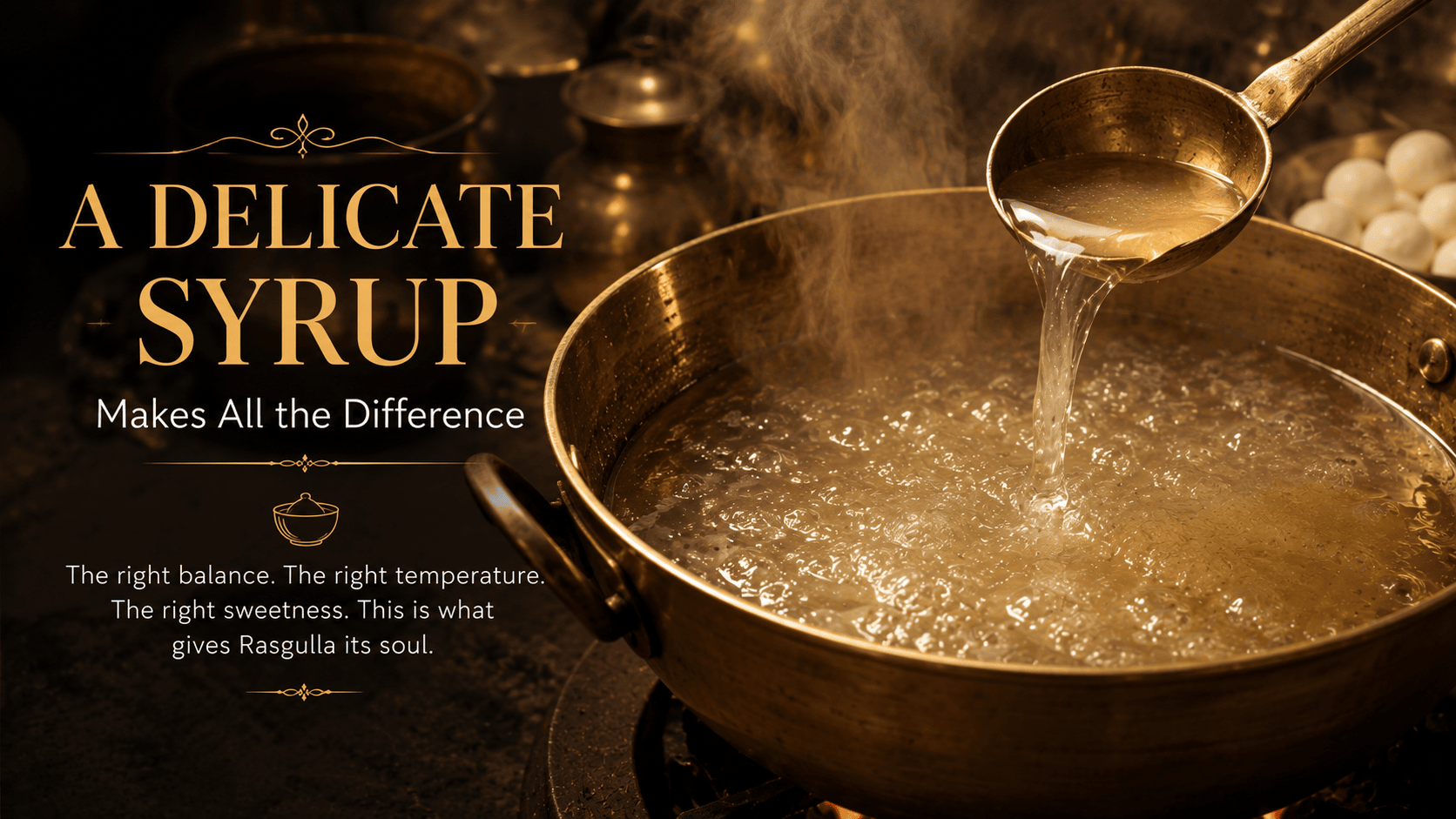
The sugar syrup for a traditional rasgulla is intentionally light and clean. Unlike many Indian sweets that use thick, heavily flavoured syrups, the rasgulla syrup is meant to be delicate, its purpose is to carry the sweetness and keep the balls soft and moist, not to overwhelm their subtle milky flavour.
The traditional ratio is roughly one part sugar to three or four parts water, creating a thin, watery syrup. This is cooked in a wide, heavy-bottomed vessel; the width is important because the balls need room to expand and move freely. The syrup is brought to a rolling boil before the rasgulla balls are added.
Some traditional recipes add a few drops of rose water to the syrup at the very end for a floral note, or a small piece of cardamom. Certain regional variations include a pinch of camphor (edible) for a distinctive fragrance. But the foundation is always the same: sugar, water and a confident boil.
Cooking the Rasgulla: High Heat and the Lid
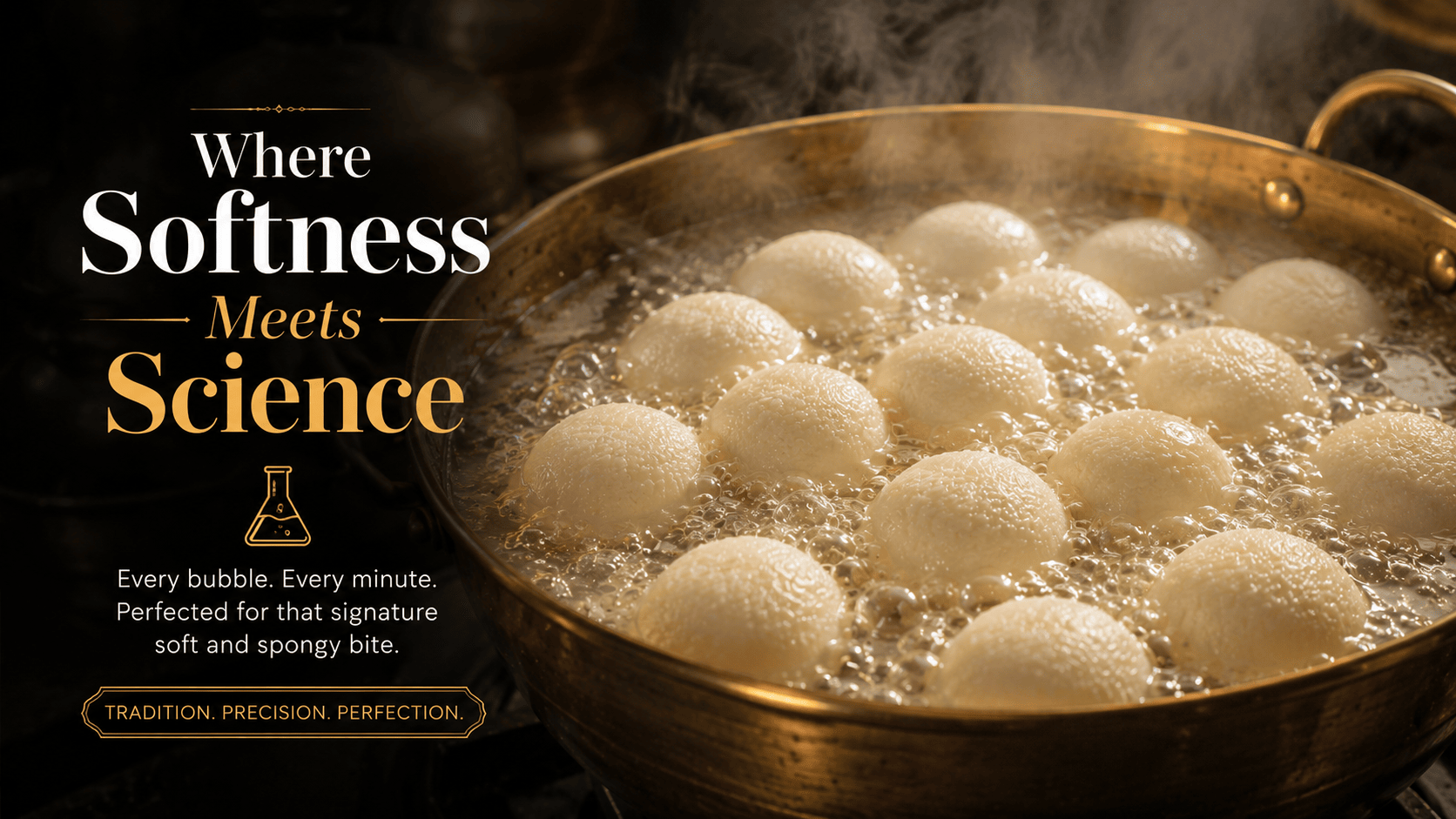
This is the most critical and counterintuitive stage for anyone new to rasgulla-making. The chenna balls go into the boiling syrup and the vessel is covered with a lid. The heat is kept high throughout the cooking process, not a gentle simmer, but a vigorous, rolling boil.
The steam created inside the covered pot is what causes the rasgullas to expand, puff up, and become spongy. Without that vigorous boil and covered environment, the balls will remain dense and chewy. Traditional halwais are very particular about this, they check the boil regularly and adjust the flame only if the syrup begins to boil over, not to reduce the intensity.
The rasgullas cook for approximately 15 to 20 minutes. During this time, they will roughly double in size, turning from small, dense balls into the light, porous spheres that make this sweet so beloved. Gently spoon a little syrup over the balls occasionally to ensure even cooking.
To check if a rasgulla is done, the traditional test is simple: drop a cooked ball into a bowl of cold water. If it sinks, it is perfectly cooked. If it floats, it needs more time. A properly cooked rasgulla is spongy throughout, press it gently and it should spring back.
Cooling and Resting: The Final Act
Once cooked, the rasgullas are allowed to cool in the syrup. This resting period is not optional; it is what allows the balls to absorb the syrup and develop their characteristic juicy softness. Traditional preparations allow the rasgullas to rest for at least two hours at room temperature before serving, and overnight chilling in the refrigerator is considered ideal by many.
As they cool, they settle into their final texture: tender, spongy, saturated with light syrup, and with that unmistakable freshness that only a traditionally made rasgulla possesses.
Regional Variations: A Sweet with Many Homes
While the Kolkata-style rasgulla is the most internationally recognised variety, white, soft, and spongy in a light syrup, traditional rasgullas exist in many regional forms across the Indian subcontinent.
Odisha claims its own ancient rasgulla tradition, with the famous Pahala rasgulla being slightly smaller, denser, and with a brownish tinge from the use of partially reduced milk. The syrup in Pahala rasgullas is often thicker and the flavour more intensely milky.
In parts of Rajasthan and Uttar Pradesh, rasgullas are sometimes prepared with a slightly grainy chenna and flavoured with saffron, giving them a golden colour and a richer, more complex flavour profile. These regional variations remind us that rasgulla is not a single recipe but a tradition, one that each region has lovingly shaped to its own taste and climate.
Why the Traditional Method Still Matters
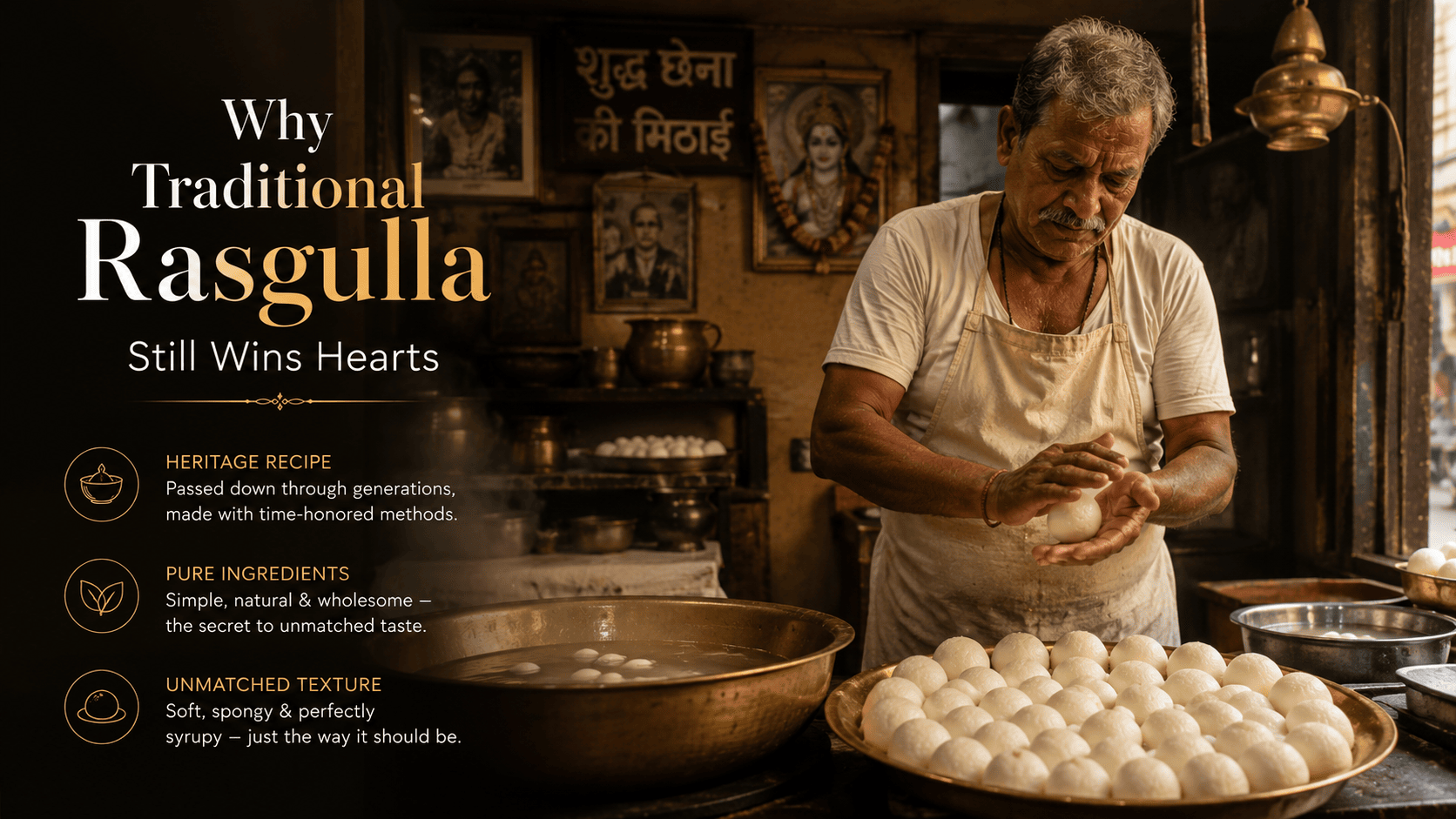
In a world of packaged sweets and mass production, the traditional rasgulla-making process remains deeply relevant. It produces a sweet that is fundamentally different from its commercial counterparts-fresher, lighter, more nuanced in flavour, and made with an intention that you can actually taste.
The process also teaches something broader: that good food takes time, that intuition built through practice is irreplaceable, and that some pleasures cannot be shortcut without losing their essence. The halwais who have perfected this craft over decades carry knowledge that no recipe can fully capture, the exact feel of properly kneaded chenna, the precise sound of a syrup at the right boil, the way a finished rasgulla springs back under a gentle fingertip.
Learning to make rasgulla the traditional way is not just a cooking lesson. It is a way of connecting with generations of sweet-makers who turned something as humble as milk and sugar into one of the world's most beloved confections.
Key Takeaways
-
Chenna quality is everything: Full-fat milk, gentle curdling, and thorough rinsing produce the soft, moist chenna that makes a great rasgulla.
-
Kneading cannot be rushed: At least 10 to 15 minutes of hand-kneading is essential to achieve a smooth, crack-free dough.
-
No cracks, no shortcuts: Even a tiny crack on the surface of a raw ball will cause it to fall apart during cooking.
-
High heat is non-negotiable: A vigorous, rolling boil under a covered lid is what creates the spongy, expanded texture of an authentic rasgulla.
-
Rest time matters: Allowing rasgullas to cool and rest in the syrup for several hours, ideally overnight, gives them their characteristic juicy softness.
-
Regional diversity is real: From Kolkata's white, airy version to Odisha's dense Pahala rasgulla, this sweet exists in many authentic traditional forms.
-
The traditional method produces a fundamentally different sweet from commercially produced versions, fresher, lighter, and made with intention.
Frequently Asked Questions (FAQ)
Q: What type of milk is best for making traditional rasgulla?
A: Full-fat cow's milk is the most widely recommended for a soft, light chenna. Buffalo milk, which has a higher fat content, produces a slightly richer and denser chenna. Many traditional halwais prefer cow's milk for the classic Kolkata-style rasgulla.
Q: Can I use vinegar instead of lemon juice to curdle the milk?
A: Yes. Both work well as curdling agents. Lemon juice tends to produce a slightly tangier chenna, while white vinegar gives a cleaner flavour. Some traditional preparations use leftover whey from a previous batch, which creates the gentlest curdling and a subtly complex flavour.
Q: Why did my rasgullas turn hard or chewy?
A: There are two common causes: insufficient kneading of the chenna, or cooking at too low a temperature. The chenna must be kneaded until completely smooth and the syrup must be at a full, rolling boil throughout cooking. Hard rasgullas can also result from over-acidifying the milk during curdling, which produces a grainy chenna.
Q: Why did my rasgullas break apart in the syrup?
A: Surface cracks in the raw balls are the most common culprit. Ensure the chenna is well-kneaded and each ball is rolled until completely smooth before it goes into the syrup. Also confirm the syrup is at the correct consistency; too thick a syrup can also cause the balls to break.
Q: How do I know when the rasgullas are fully cooked?
A: The classic test is to drop a cooked rasgulla into a bowl of cold water. If it sinks to the bottom, it is done. If it floats, it needs more time in the syrup. A properly cooked rasgulla should also have roughly doubled in size and spring back when pressed gently.
Q: How long do traditional rasgullas keep, and how should they be stored?
A: Traditional rasgullas keep well for 2 to 3 days at room temperature in their syrup and up to a week in the refrigerator. They should always be stored submerged in syrup to retain their moisture and softness. Avoid freezing, as this damages the spongy texture.
Q: Is the Kolkata rasgulla different from the Odisha rasgulla?
A: Yes, they are distinct in both appearance and texture. The Kolkata rasgulla is white, very soft, and spongy, cooked in a light sugar syrup. The Pahala rasgulla from Odisha is smaller, denser, slightly brownish in colour, and made with a thicker syrup and a more intensely milky flavour. Both are authentic traditional preparations with long regional histories.
Craving authentic rasgulla without the effort? Shop K.C. Das Rossogolla-India's most iconic Bengali sweet, delivered fresh to your door Order Now on DeliciousKart