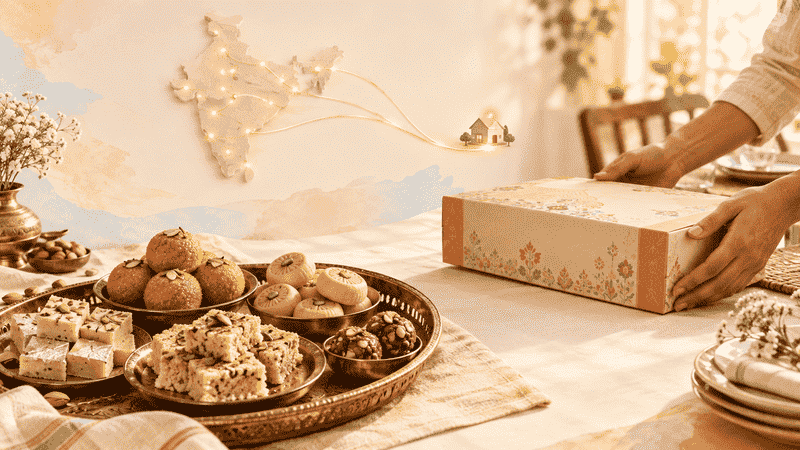
Yes, you can order authentic Indian sweets online and get them delivered across India, and you no longer need a cousin's suitcase or a long train ride to make it happen. The short version goes like this. Decide whether you're buying by city, by type of sweet, or for a specific occasion. Check that your pincode is serviceable. Read the product page for weight, ingredients and shelf life. Then place the order and keep an eye out for the courier.
The longer version is what this guide is about. Sweets delivery online has come a long way from the days of a vague photo and a phone number. But it's also easy to get wrong if you don't know what to look for, especially when the sweet you're chasing is something a single town has perfected over generations. We'll talk about why buying heritage mithai online makes sense, how to pick the right box, what to know about delivery and coverage, and how to store what arrives. We'll also be upfront about the trade-offs, because there are a few.
How to Order Authentic Indian Sweets Online (The Quick Answer)
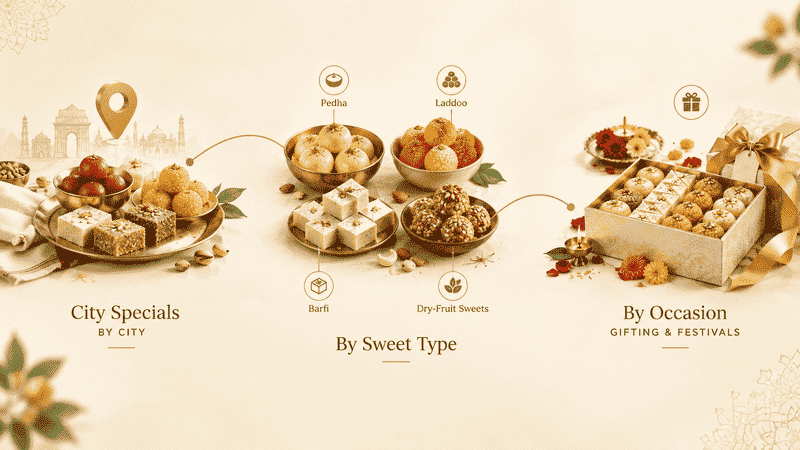
Start with the question that matters most: what are you actually craving, or who are you buying for? If you're after a specific taste from a specific place, browse by city. If you just want a good assortment for the house, browse by sweet type. If it's a wedding, Diwali, Raksha Bandhan or a thank-you for someone who deserves more than a bouquet, start from the gifting collections.
Once you've found something you like, open the product page and read it properly. Good listings tell you the sweet's origin, the pack weight, the main ingredients, and how long it stays good. Then check delivery for your pincode before you get too attached to the idea, because coverage is the one thing that can quietly ruin a plan. Our Shipping Policy and the Delivery Time and Cost page explain how this works, and we'd rather you read those than take anyone's word for it, including ours in a blog post.
If you're the browsing type, the full sweets collection is a decent place to begin, and the Traditional Sweets and Mithai category groups the classics together.

Why Buy Heritage Sweets Online?
Ask anyone who has moved away from their hometown what they miss most, and food will be near the top of the list. Not restaurant food, either. It's the specific things: the pedha from the shop near the temple, the barfi your nani always kept in a steel dabba, the one sweet that shows up at every family function. India has thousands of these, and most of them never left their home city because they were made in small batches by families who saw no reason to expand.
The problem with "just get it from a local shop"
Local mithai shops are wonderful, and we're not going to pretend otherwise. But they solve a problem for people who already live nearby. If you're in Bengaluru and the sweet you want comes from Rajasthan, or you're in Delhi and you've been thinking about a Bengali classic since last Durga Puja, your options used to be limited. You could wait for a trip. You could ask a friend to carry a box. Or you could settle for a mass-produced imitation that has the name right and almost nothing else.
Buying heritage sweets online closes that gap. A good online store works with makers who are known for one particular thing and ships their work to people who can't get to them. That's the real value. It's not convenience for convenience's sake. It's access.
Why city-special mithai deserves its own attention
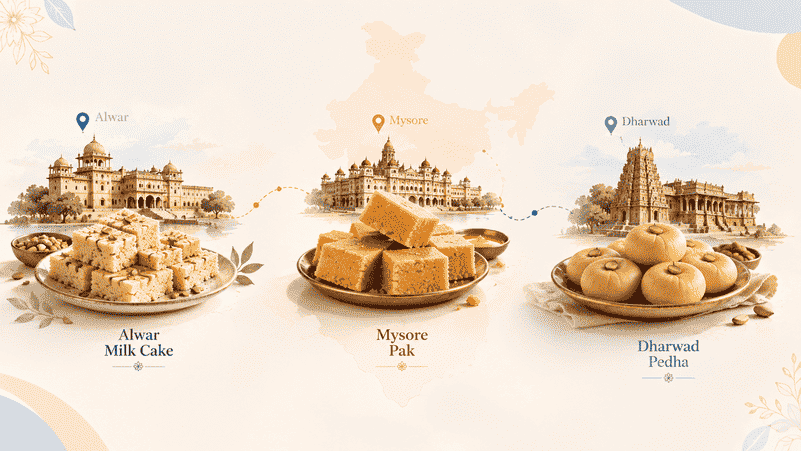
Indian sweets are regional in a way that's hard to overstate. Bengal leans on chhena and jaggery, and gave us the rasgulla, which even ended up in a well-known Geographical Indication dispute between West Bengal and Odisha before both states received recognition for their own versions. Mysuru has its ghee-heavy Mysore Pak. Agra has petha, Dharwad has its pedha, Bikaner is famous for its bhujia and its sweets. Each of these came from local ingredients, local water, local climate, and local habits. Move the recipe, and you often lose something.
That's why the origin matters when you shop. A sweet made in the city it's known for, by people who've been making it for years, is a different product from a lookalike made in a factory two states away.
A small example: Milk Cake from Alwar
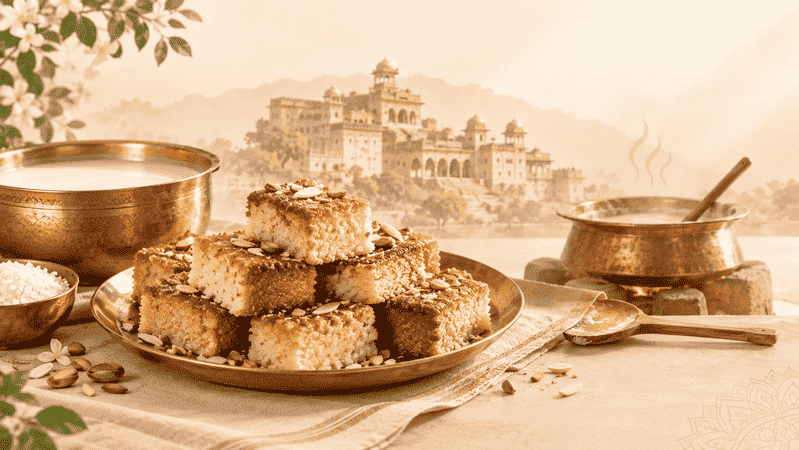
If you want a single example that explains all of this, look at Milk Cake from Alwar. It's a slow-cooked milk sweet, dense and slightly grainy, with a caramelised, golden-brown edge and a deep, toasty milk flavour. It's often described as a cousin of kalakand, and you can read a general overview of that family of sweets on Wikipedia. Local tradition in Alwar credits particular halwais with making it famous, and if you've ever eaten it fresh in the city, you'll know why people carry boxes of it home.
What makes it interesting is how simple it is. The ingredients are milk, sugar, and patience. The skill is in the heat, the stirring, and knowing exactly when to stop. That's not something you can shortcut, and it's also why a factory version tastes flat. When someone tells you they want "real" Alwar Milk Cake, they mean the one that was cooked by someone who's done it a thousand times. Being able to order a sweet like that from another city, without leaving your sofa, is exactly the sort of thing sweets delivery online should be doing.
What Does "Authentic" Actually Mean?
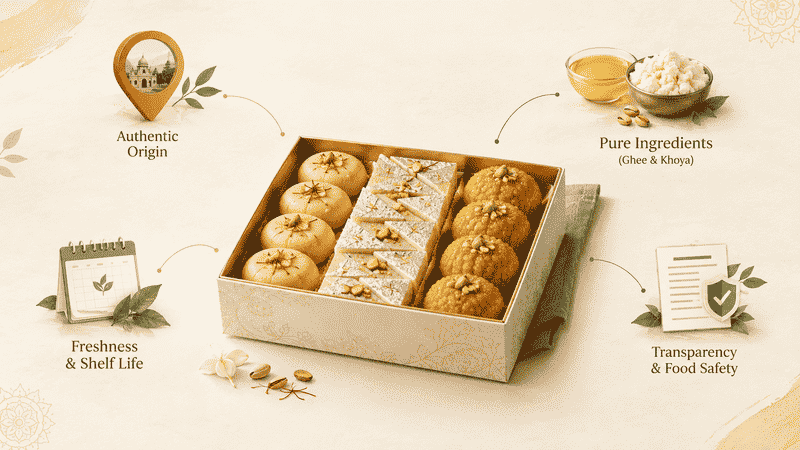
The word gets thrown around so much that it's nearly meaningless, so let's be practical about it. When we say a sweet is authentic, we mean four things.
First, it comes from the place it's associated with, or from a maker who follows that place's method. Second, it uses the ingredients the recipe calls for. Real ghee, real khoya or mawa, real dry fruits, not cheaper substitutes that cut costs and change the taste. Third, it's made in reasonable batches and packed fresh rather than sitting in a warehouse for weeks. Fourth, the seller is honest about all of it: where it's from, what's in it, and how long it lasts.
That last point is where trust comes in. In India, any food business is expected to hold a valid licence from the Food Safety and Standards Authority of India, and you can read about the rules on the official FSSAI website. A licence number on a seller's site isn't proof of quality by itself, but its absence is a red flag. It's one of the quickest checks you can do before you hand over your money, and it takes about ten seconds.
Also look for the small signs of care. Does the listing name the maker or the city? Does it give a weight and a shelf life? Is there a clear way to reach someone if something goes wrong? Stores that bother with these details usually bother with the sweets, too.
How to Choose: By City, By Sweet Type, By Gifting Need
There are three good ways to shop, and you can mix them depending on your mood. None is better than the others. It's about which one matches the reason you're buying.
Choosing by city
This is the route for anyone chasing nostalgia or curiosity. If you grew up in a particular city, or you're planning a trip and want a preview, or you're sending something to a friend from a place they miss, the city-special approach is unbeatable. You're buying a sweet with a postcode attached to its reputation.
The City Special collection, also listed under Regional Favourites, is built around this idea. Browse it the way you'd wander through a market in a city you don't know. Pick one or two things you recognise and one or two you've never heard of. That's usually how you end up finding a new favourite.
Choosing by sweet type
Sometimes you don't care where it's from. You just know you want something milk-based, or something with nuts, or something that isn't too sugary. Thinking in categories helps here. Milk-based sweets like pedha, barfi, kalakand and Milk Cake are rich and soft, and they taste best when they're fresh. Ghee-based sweets like laddus, Mysore pak and soan papdi are denser and often travel better. Dry-fruit sweets are lighter on the palate and popular for gifting. Syrup-soaked sweets like gulab jamun and rasgulla are a different thing altogether and need more careful packing.
If you're unsure, ask yourself who's going to eat it. Older relatives often prefer the classics they grew up with. Kids usually go for something colourful and familiar. Guests you don't know well are safest with a mixed box. The Traditional Sweets and Mithai page lets you browse the whole range by category.
Choosing by gifting need
Gifting is where most online sweet orders actually happen, so it deserves a little strategy. For festivals, a hamper usually works better than a single box, because it feels considered. Our Festive Gift Hampers are put together for exactly those moments. If you want something that feels a little more special, such as a wedding gift, a corporate thank-you, or an anniversary, the Regal Sweets and Treats collection leans towards richer, more premium options.
A few things are worth remembering when you're sending a gift. Order early during festival weeks since everyone else is doing the same. Write the recipient's address and a working phone number carefully because couriers do call. And think about whether the person will actually be home, because a box of milk sweets sitting on a doorstep for a day is a sad thing.
Three Real-Life Situations Where Online Sweets Save the Day
We hear the same kinds of stories again and again, so here are three situations that will probably sound familiar. They're composites of common scenarios rather than individual customer testimonials, but they show how people actually use sweets delivery online.
The first is the homesick student or professional. Someone living in a new city, working long hours, misses the specific mithai from their hometown. A sweet they can't find locally, a box ordered on a Sunday afternoon, and a small piece of home arrives. It sounds minor, but for a lot of people it's the highlight of the month.
The second is the long-distance festival sender. A family in Pune wants to send Diwali sweets to grandparents in Jaipur, and they'd like it to be something the grandparents will actually recognise rather than a generic assorted box. Picking from a city-special range lets them do that without a single phone call to a shop they can't visit.
The third is the last-minute host. Guests are coming, the plan was to buy sweets on the way home, and the plan has collapsed. Ordering ahead, even a couple of days earlier, from a store that ships across the country means the table isn't empty. It's a small victory, but anyone who's hosted knows how good it feels.
Delivery, COD and Coverage: What You Should Know
Now for the part that matters as much as the sweets. Nobody wants to fall in love with a box of mithai and then find out it can't reach their pincode. We serve customers with all-India delivery as the goal, but serviceability ultimately depends on your pincode and the courier network, and the honest way to handle that is to check rather than assume.
Here's what we'd suggest. Before you build a big cart, enter your pincode on the product page or at checkout and see whether it's accepted. Then read the Shipping Policy and the Delivery Time and Cost page. That's where the current delivery timelines, charges, and conditions live, and they're the source of truth. We deliberately don't quote fixed timings or fees in a blog post, because those things can change, and we don't want you making a decision based on stale information.
On payment, the store's Payment Method page lists what's currently accepted. If you're specifically looking for cash on delivery, check there and at checkout to see whether it's offered for your order and location. If something's unclear, the FAQ is worth a look, or you can reach the team through Get Support.
One more practical tip. Delivery to remote areas, or during peak festival weeks, can take longer than usual. If you're ordering for a specific date, give yourself a buffer of a few days. Sweets are worth planning for, and nothing is more frustrating than a Rakhi package that shows up on the wrong side of the festival.
Keeping Your Sweets Fresh After They Arrive
You've done the hard part, and the box has arrived. Here's how to make sure the sweets are still at their best when you open it.
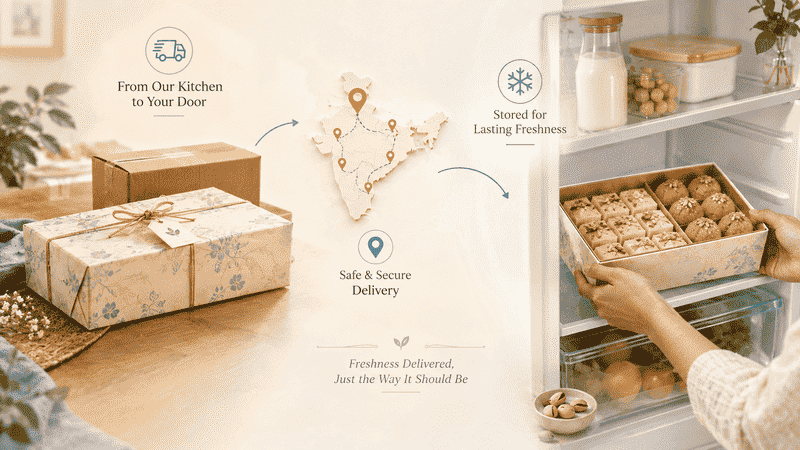
Open the package soon after it arrives and check that everything looks and smells the way it should. Read the label for the shelf life and storage instructions, and follow them, because different sweets behave very differently. Milk-based sweets like Milk Cake and pedha are generally happiest in a cool place and, depending on the label, may benefit from the fridge. Dry sweets and ghee-based laddus are usually more forgiving. If the label says to eat within a certain number of days, take that seriously, since fresh milk sweets don't have the long life of a packaged biscuit.
One trick that helps: take milk sweets out of the fridge about half an hour before serving. They go from firm and slightly dull to soft and properly fragrant. It sounds like a small thing, but it makes a real difference to the flavour.
If anything arrives damaged or doesn't look right, contact support quickly and keep photos of the package. The Return and Refund Policy explains how food items are handled, and it's better to read that before you need it.
The Honest Pros and Cons of Buying Sweets Online
We're a sweets store, so we obviously think ordering online is a good idea. But a fair guide should tell you what you gain and what you give up, so here's a straight look at both.
On the plus side, you get access to sweets you'd never find locally, and that's the big one. You can compare options at your own pace instead of being hurried by a queue. Gifting to another city becomes simple, since you don't have to carry anything. And you can read details about ingredients and weight before you buy, which is harder to do at a crowded counter.
On the other hand, you can't taste before you buy, and no photo fully replaces the smell of a fresh batch. Delivery takes time, so it's not the right choice when you need something in the next hour. Perishable sweets need some care once they arrive. And shipping costs and coverage vary, which is why we keep pointing you to the policy pages. For most people, the trade-off is worth it, especially for sweets they can't get any other way. But it helps to walk in with realistic expectations.
Where to Explore Next
If you'd like to keep browsing, here are a few good starting points on Deliciouskart. The main sweets collection gives you the broad view. The City Special collection is ideal if you're chasing a particular place. For richer, premium options, head to Regal Sweets and Treats. If you're planning a gift, the Festive Gift Hampers and the Double Delight Festive Collection are worth a look. And if you just want to see what's fresh, the New Arrivals page is updated as new products come in.
If you'd like to know who's behind the store, the About Us page tells that story, and the blog has more guides like this one.
Frequently Asked Questions
Q. Can I buy authentic Indian sweets online?
A. Yes. Many stores now sell regional and heritage sweets online, and the best ones tell you where each sweet comes from, what goes into it and how long it stays fresh. To judge authenticity, look for a named origin or maker, real ingredients like ghee and khoya, a clear shelf life, and a visible food safety licence. On Deliciouskart, you can browse the Traditional Sweets and Mithai and City Special collections to find sweets tied to specific places.
Q. Do you deliver sweets all over India?
A. Our aim is all-India delivery, but whether a particular order can reach you depends on your pin code and courier coverage. The simplest way to find out is to enter your pincode at checkout. For the latest details on timelines, charges and conditions, please read our Shipping Policy and the Delivery Time and Cost page rather than relying on general estimates.
Q. Is cash on delivery available?
A. Payment options can differ by product, order and location. Check the Payment Method page and the options shown at checkout to see what's available for your order. If you can't tell, reach out through Get Support.
Q. How long will milk-based sweets like Milk Cake stay fresh?
A. It depends on the sweet and the pack, so the label on your product is the best guide. As a general rule, milk-based sweets have a shorter shelf life than dry or ghee-based ones and do best in cool conditions. Follow the storage instructions printed on the pack, and let refrigerated sweets sit at room temperature for a short while before you eat them.
Q. What's the best way to choose sweets for a gift?
A. Think about the person first, then the occasion. A mixed box suits guests whose tastes you don't know well. A city-special pick works when you know where someone grew up. For festivals and weddings, a hamper feels more thoughtful. You can explore ready-made options in the Festive Gift Hampers and Regal Sweets and Treats collections.
Q. What if my order arrives damaged?
A. Contact support as soon as you can and keep photos of the package and the sweets. The Return and Refund Policy explains what applies to your situation, and acting quickly makes it easier to sort things out.
Key Takeaways
You can buy authentic Indian sweets online, and the real benefit is access to city-special mithai you can't find locally.
Authentic means a genuine origin, proper ingredients, fresh packaging, and an honest seller, so check for a named maker or city and a visible FSSAI licence.
Choose by city for nostalgia, by sweet type for taste, and by gifting need for occasions, and mix the three as you like.
Always check your pincode and read the Shipping Policy and Delivery Time and Cost pages before relying on any delivery estimate.
Store milk sweets like Alwar Milk Cake according to the label, and contact support quickly if something arrives damaged.
Ready to taste something from your favourite city? Explore authentic Indian sweets, city specials and festive hampers at Deliciouskart.com and order your box today.