

"We prefer wooden moulds for their quality."
That's how the craftsmen at Nalin Chandra Das & Sons describe their approach to sandesh-making a small sentence that says a lot about a shop that's been shaping Bengal's sweets by hand for over 175 years. It's the kind of quiet confidence that only comes from doing one thing really well for generations. And it's exactly the philosophy baked into their most talked-about creation right now: the Chocolate Jalbhara Sandesh, a sweet that takes a centuries-old Bengali classic and gives it a cocoa-rich, thoroughly modern twist.
If someone's ever bitten into a jolbhora sandesh and had it release a burst of syrup mid-chew, they already know why this category of sweet has such a cult following. Now imagine that same surprise, but chocolate. That's the premise behind this sweet, and it's worth unpacking why it's become such a favourite for people who take their mithai seriously.
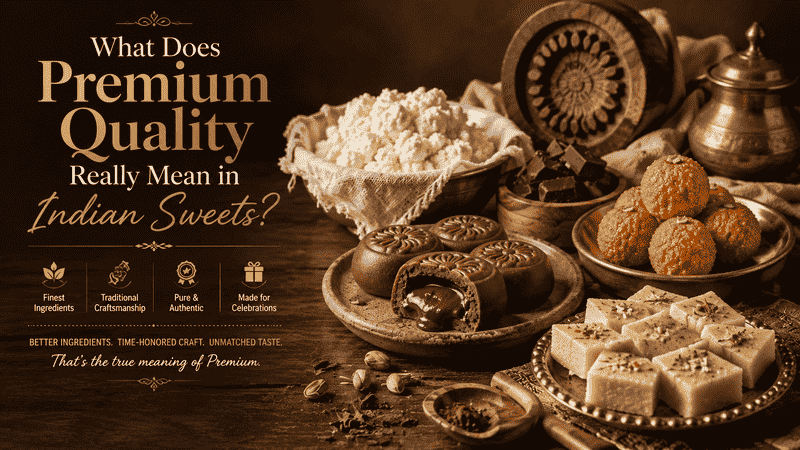
What Does "Premium Quality" Really Mean in Indian Sweets?
The word "premium" gets thrown around a lot in India's sweet aisle these days, so it helps to define it properly before applying it to any one sweet.
India's packaged sweets market is going through a genuine premiumization wave. Industry analysis shows the market was valued at roughly ₹8,431 crore in 2025 and is expected to grow at a compound annual rate of over 15% through 2034, with shoppers increasingly willing to pay more for authenticity, craftsmanship, and elevated ingredients rather than mass-produced sameness (IMARC Group). During the last festive season, some artisanal mithai think rose-infused kaju katli or saffron-and-edible-gold barfi were commanding prices upwards of ₹1 lakh per kilogramme, a sign of just how far the luxury end of this category has come.
So when a sweet is described as premium quality, it usually means a combination of things: fresh, high-grade ingredients (not shortcuts like vanaspati or synthetic flavouring), traditional technique executed without compromise, thoughtful packaging that's actually gift-worthy, and a brand name that carries real heritage rather than a manufactured story. Nalin Chandra Das & Sons checks every one of those boxes, which is exactly why their sweets keep showing up on best-of lists for Bengali mithai.
It also helps to understand why this shift is happening now. A generation of Indian consumers that grew up with easy access to global food culture artisanal chocolate, specialty coffee, small-batch everything has started applying the same expectations to mithai. They're comparing a box of sandesh to a box of Belgian pralines, not to the sweets sold loose at a neighbourhood counter. That comparison sets a high bar, and it's one that only brands with genuine technique can clear. A shop can print "premium" on a box, but consumers have gotten noticeably better at telling the difference between a label and the real thing, which is exactly why heritage brands with decades of hands-on craft are the ones benefiting most from this shift, rather than newer entrants trying to shortcut their way into the category.
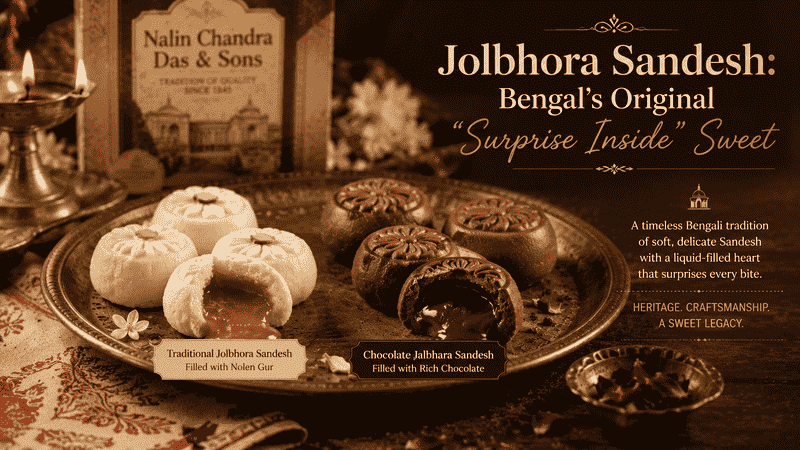
Jolbhora Sandesh: Bengal's Original "Surprise Inside" Sweet
To appreciate the chocolate version, it helps to understand where jolbhora sandesh itself comes from. The sweet originated in Chandannagar, West Bengal, and its name comes directly from two Bengali words Jol (water or liquid) and bhora (filled) describing the syrup hidden at its centre.
According to popular accounts, the sweet was invented by Surya Kumar Modak, who adapted a drier, more traditional sweet called talsansh by injecting a small amount of liquid nolen gur (date palm jaggery syrup) into the centre. The result was a sandesh that released a burst of syrup the moment someone bit into it a small, delightful shock that turned an ordinary sweet into something people would travel across the city for. Traditionally, the sweet is tiny, just a few centimetres in each direction, which is part of the charm it's built for a single, satisfying bite.
That "surprise centre" concept is the whole reason jolbhora became such a beloved sub-category of sandesh in the first place, and it's the exact mechanic that Nalin Chandra Das & Sons borrows and reinvents in their chocolate edition.
The Chocolate Jalbhara: Where Tradition Meets Cocoa
Instead of nolen gur, the Nalin Chandra Das Jalbhara (Chocolate) fills its centre with rich, liquid chocolate, wrapped inside a soft chhena-based shell. The result, as the brand itself describes it, is a sweet that fuses "the soft, creamy texture of authentic Sandesh with a luscious chocolate-filled centre that surprises you with every bite" available to order directly through DeliciousKart.
It's an easy sweet to describe but a genuinely clever one to make. The chhena shell has to be delicate enough to melt in the mouth, sturdy enough to hold a liquid filling without leaking, and balanced enough in sweetness that the chocolate centre doesn't overwhelm the dairy notes underneath. Getting that balance right is exactly the kind of thing a shop only nails after generations of practice, which loops back neatly to why the "175-year legacy" angle isn't just an excellent story; it's functionally why this sweet works.
For anyone who grew up on classic sandesh and finds themselves equally weak for a good chocolate dessert, this is very much a "why choose" sweet because here, someone doesn't have to.
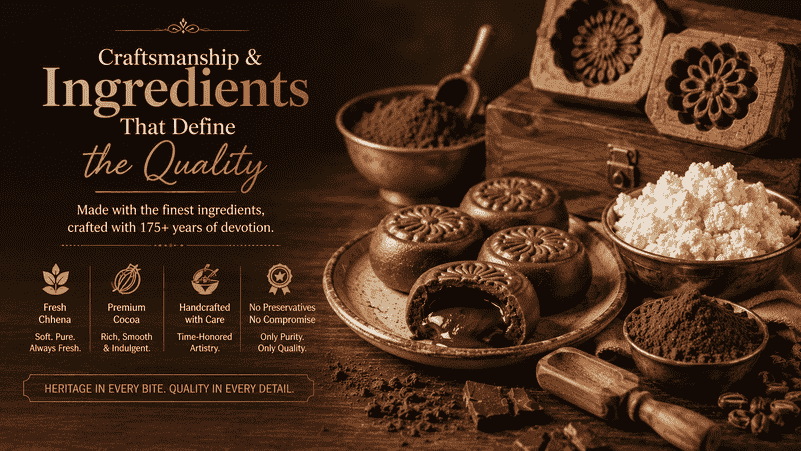
Craftsmanship and Ingredients That Define the Quality
A big part of what makes this sweet stand out is what it doesn't contain. Made from fresh chhena and good-quality chocolate, with no preservatives, it leans on freshness rather than shelf-stabilising additives a decision that says a lot about how the brand thinks about quality versus convenience.
A few things worth knowing about the craft behind it:
-
Chhena freshness matters more than people realise : Sandesh made from chhena that's even a few hours old starts to lose the soft, almost cloud-like texture that defines a good sandesh.
-
Wooden moulds aren't just tradition for tradition's sake : As the makers themselves note, seasoned wood is naturally hygienic, water-resistant, and easy to keep clean for practical reasons layered on top of the aesthetic ones.
-
Balancing the filling is a craft skill : Too little chocolate and the "surprise" falls flat; too much and the shell can't hold its shape. That balance is essentially the entire art form of jalbhara-style sweets.
None of this is complicated to explain, but it's genuinely difficult to execute consistently, which is exactly the gap between a sweet that's "fine" and one that people specifically order online for a special occasion.
There's also a quieter craftsmanship element that's easy to overlook: consistency at scale. It's one thing to make a handful of perfect jalbhara sandesh for a single family gathering. It's an entirely different challenge to make hundreds of them, every single day, with the same shell thickness, the same amount of filling, and the same texture, day after day, year after year. That kind of repeatable precision is usually where mass-market brands start cutting corners: thicker shells, less filling, more stabilisers to make the product more forgiving to produce. A shop with 175 years of institutional memory has had time to solve that problem the right way, through skilled hands and refined technique, rather than through additives that make the process easier but the sweet less special.
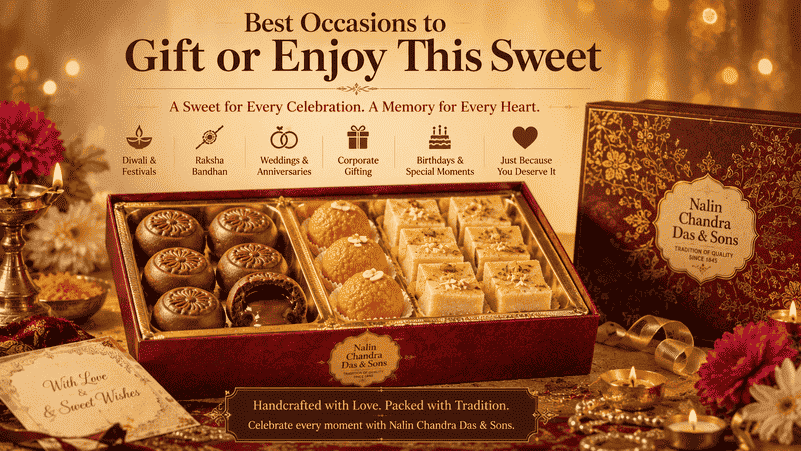
Best Occasions to Gift or Enjoy This Sweet
Because it sits right at the intersection of tradition and indulgence, this sweet tends to show up at a wide range of occasions across India, including:
-
Durga Puja and Diwali : where Bengali sweets are practically a cultural requirement
-
Raksha Bandhan : where a box of good mithai is a near-universal gesture
-
Weddings and anniversaries : where guests expect something a little more elevated than the everyday
-
Birthdays : especially for someone who loves both traditional sweets and chocolate
-
Corporate and festive gifting : a segment that's growing fast as more companies look for culturally rooted, premium options that feel personal rather than generic a trend one 2026 corporate gifting guide points out is being driven by demand for personalization and premium packaging alongside classic favourites.
It also, frankly, works as a "just because" treat. Not every great sweet needs a festival attached to it.
There's an argument to be made that this sweet is at its best in exactly those low-key moments: a quiet evening at home, a small get-together with close friends, or a solo treat after a long week. Big festive spreads tend to feature a dozen different sweets competing for attention, which means a subtler, more intricate sweet like a jalbhara can get lost in the shuffle. Serve it on its own, though, with nothing else competing for attention, and the contrast between the soft chhena shell and the rush of chocolate at the centre gets to properly shine. Some of the best mithai experiences in India happen exactly like that not at the biggest celebration of the year, but in a small, unhurried moment where someone can actually pay attention to what they're eating.
How India's Mithai Market Is Embracing Fusion Sweets in 2026
This chocolate-and-chhena hybrid isn't happening in isolation; it's part of a much bigger shift in how India eats sweets. Market researchers project mithai in India could be worth roughly ₹800 billion by 2026, with brands increasingly experimenting with fusion formats that bring modern flavours into traditional forms (GourmetPro). Separate analysis projects the broader India sweets market will grow at over 8% annually through 2031, with online retail specifically expected to grow close to 10% a year as quick commerce and e-commerce platforms make it easier than ever to order authentic regional sweets from outside one's own city (Mordred Intelligence).
That online shift matters a lot for a Kolkata-rooted brand like Nalin Chandra Das & Sons. It means someone in Bengaluru, Delhi, or Pune no longer has to book a flight to Kolkata to get an authentic taste of Bengal; they can order it through platforms built specifically around India's regional food heritage.
There's a second, quieter trend feeding into this too: India's growing appetite for regional food discovery. As more people move cities for work and more NRIs look to reconnect with hometown flavours from abroad, "city special" and heritage-brand sections on food platforms have become genuinely popular browsing categories, not just niche add-ons. Someone from Kolkata living in Hyderabad can now order the exact sweet shop their grandmother used to visit, rather than settling for whatever's available locally. For a fusion product like the Chocolate Jalbhara modern enough to appeal to a broader, younger palate, but rooted enough to satisfy someone craving authentic Bengali sandesh that combination of nostalgia and novelty is a genuinely powerful reason it's finding new fans well outside West Bengal.
Ordering, Storage, and Serving Tips
For anyone ready to try it, the Nalin Chandra Das Jalbhara (Chocolate) is available in a 500g pack through DeliciousKart, which also runs a dedicated Shop by Brand section where Nalin Chandra Das sits alongside other heritage Indian sweet makers. A few practical tips for getting the most out of it:
-
Refrigerate on arrival : Sandesh with a liquid filling is best kept cool, especially in warmer parts of India.
-
Bring it to room temperature before serving : Straight-from-the-fridge sandesh can taste duller than it should; a few minutes out of the fridge lets the flavours open up.
-
Eat it fresh : Since the product is made without preservatives, it's meant to be enjoyed within a short window rather than stored for weeks.
-
Handle gently when unpacking or gifting : The liquid-filled centre is part of the charm, but it also means the sweet is more delicate than a dry barfi or laddoo.
-
Pair thoughtfully if serving alongside other sweets. : Since the flavour profile is richer than a plain sandesh, it tends to work best next to lighter, less sugary options rather than other heavily chocolate-forward desserts, so the filling stays the star of the plate rather than competing with something equally intense.
For anyone gifting it rather than eating it themselves, it's worth adding a short note about how to enjoy it. Many people who've never tried a jalbhara-style sweet before don't expect the liquid centre, and a small heads-up turns a potentially messy first bite into the fun surprise it's meant to be.
Key Takeaways
-
Nalin Chandra Das & Sons is a fourth-generation, 175-year-old Kolkata sweet house known for authentic sandesh craftsmanship.
-
Jolbhora sandesh originated in Chandannagar, West Bengal, traditionally filled with liquid nolen gur.
-
The Chocolate Jalbhara reinvents that classic by swapping the syrup centre for liquid chocolate inside a soft chhena shell.
-
It's made without preservatives, positioning it as a genuinely premium quality sweet rather than a mass-market one.
-
It suits everything from festive gifting to weddings to a simple weekend indulgence.
-
India's premium and fusion mithai segment is growing fast, and online ordering is making heritage sweets like this one accessible nationwide.
FAQs
Q: What exactly is Jalbhara sandesh?
A: It's a Bengali sandesh with a liquid-filled centre traditionally date palm jaggery syrup that releases when bitten into. The name comes from the Bengali words for "water" and "filled."
Q: What makes the chocolate version different from traditional Jalbhara?
A: Instead of a syrup filling, the Nalin Chandra Das Jalbhara (Chocolate) uses a liquid chocolate centre inside the same soft chhena-based shell, blending Bengali tradition with a modern chocolate twist.
Q: Is this sweet actually premium quality, or is that just marketing language?
A: The ingredients (fresh chhena, quality chocolate, no preservatives) and the heritage craftsmanship behind a 175-year-old sweet house both support the premium positioning, rather than it being packaging alone.
Q: How should this sweet be stored?
A: Keep it refrigerated and consume it within a short window since it's made without preservatives. Bring it to room temperature briefly before serving for the best texture and flavour.
Q: What occasions is it best suited for?
A: It works well for Durga Puja, Diwali, Raksha Bandhan, weddings, birthdays, and corporate or festive gifting as well as simply as a treat for chocolate and sandesh lovers alike.
Q: Where can it be ordered online in India?
A: It's available through DeliciousKart's product page, along with other Nalin Chandra Das offerings listed under the platform's dedicated brand collection.
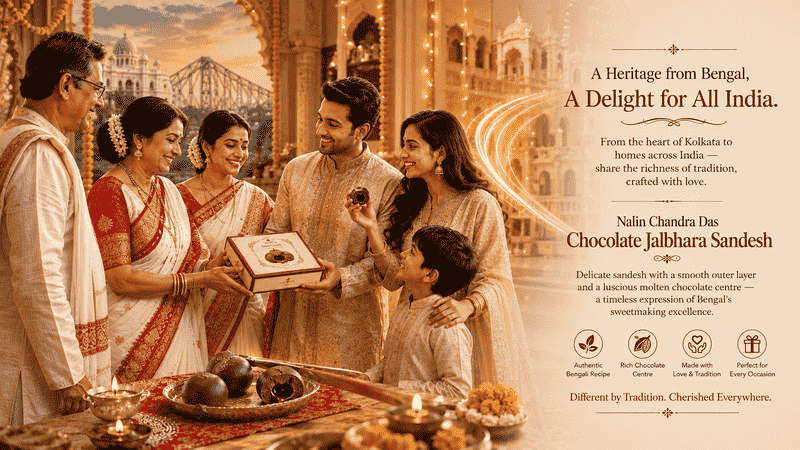
Looking for a premium quality sweet for gifting or celebrations? Explore Nalin Chandra Das Jalbhara (Chocolate) on DeliciousKart today.